
The craft fair display ideas that matter most are a covered table that reaches the floor, items raised to different heights, a clear sign and an easy way to pay. A budget first outdoor booth with a canopy, weights, a table, table covers, risers, lights and a card reader came to about $244 when I priced it, and booth fees at eight 2026 craft shows I looked up ran from $50 to $575, so the cheaper local fairs are the easiest place to make that money back.
I haven’t run a craft fair booth myself. The display ideas come from the articles that rank for this search and the shows’ own rules for sellers, and the prices and fees are what I found on November 26, 2026, from the makers’ sites, store listings and each show’s own page for sellers. Most of these 2026 shows have already happened and fees change every year, so check your own show before you buy anything.
12 craft fair display ideas, with what they cost
1. Start with a 10 by 10 canopy (outdoor shows)
Many outdoor shows rent you a 10 by 10 foot space and expect you to bring your own tent, and Franklin’s Main Street Festival in Tennessee asks for a white 10 by 10 one. A few supply the tent, like Moore Square’s Winterfaire in Raleigh, and the Fairfax Fall Festival says a canopy is highly recommended but not required, so read your show’s page first. E-Z UP’s shelters by price page starts its 10 by 10 Vista at $118.20, and budget pop-up canopies from other brands were about $75 to $135 in the listings I checked. The Worthington, Ohio holiday fair says no pop-up tents are allowed indoors, so skip this purchase if you only plan to do indoor shows.
2. Weight every leg of the tent
Shows check tent weights, and Eugene Saturday Market, the Fairfax Fall Festival in Virginia and the Violet Crown Festival in Texas each require at least 25 pounds on each tent leg, while Franklin’s Main Street Festival requires 40 pounds per leg and says unweighted tents won’t pass inspection. Virginia Beach’s Neptune Festival asks for 50 pounds per leg plus a tent rated for 60 mph wind.
Read weight listings carefully, because a “40 lb” set of four can be 10 pounds per leg, which falls short of every rule here. Water bags that hold about 55 pounds each cost about $43 to $48 for a set of four, enough for even a 50 pound rule, but Eugene’s 2025 policy doesn’t accept water jugs or weights encased in plastic, so they likely won’t pass there. Empty sandbags you fill yourself were about $12 to $16 a set plus the sand, and the set I looked at holds about 35 pounds a bag, enough for a 25 pound rule but not Franklin’s 40 or Virginia Beach’s 50.
3. Cover the table to the floor
A cloth that reaches the floor makes a plain folding table look finished and also hides your spare stock and bins underneath. A light 6 foot fold-in-half table was about $36, sturdier commercial-style 6 foot tables like Lifetime’s ran about $100 to $125 at the retailers I checked, and a fitted stretch cover for a 6 foot table was about $13 for a 2-pack.
4. Raise items to different heights
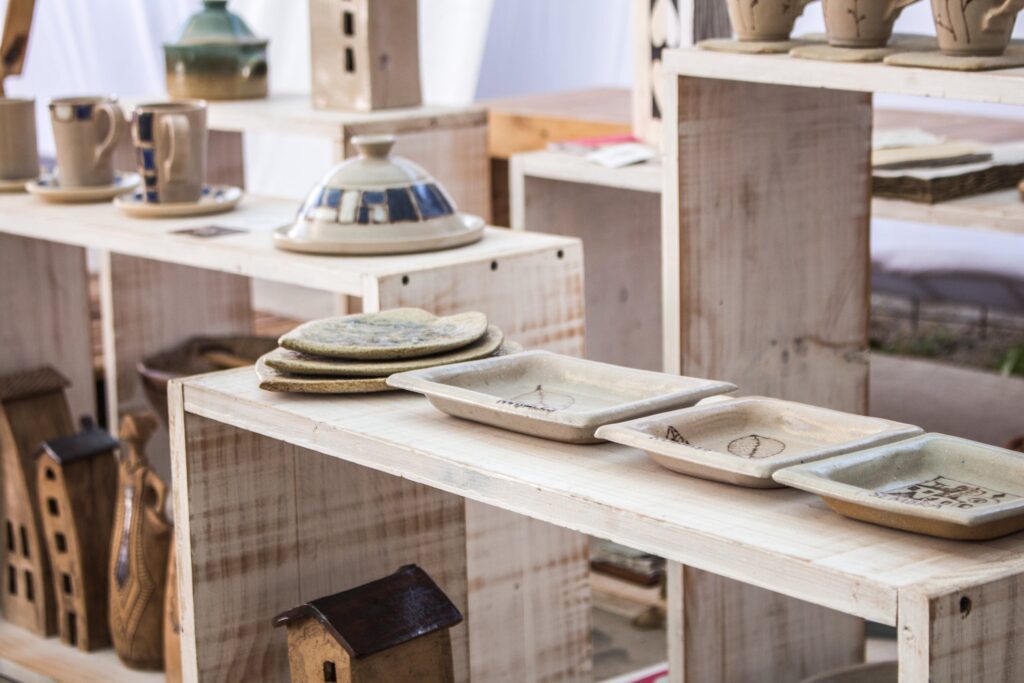
Putting some items up high with risers, crates or shelves makes a table easier to see from the aisle than a flat spread. Wooden tiered risers cost from about $12 for a set of three to $30 for a 4-tier stand.
5. Group items in threes or fives
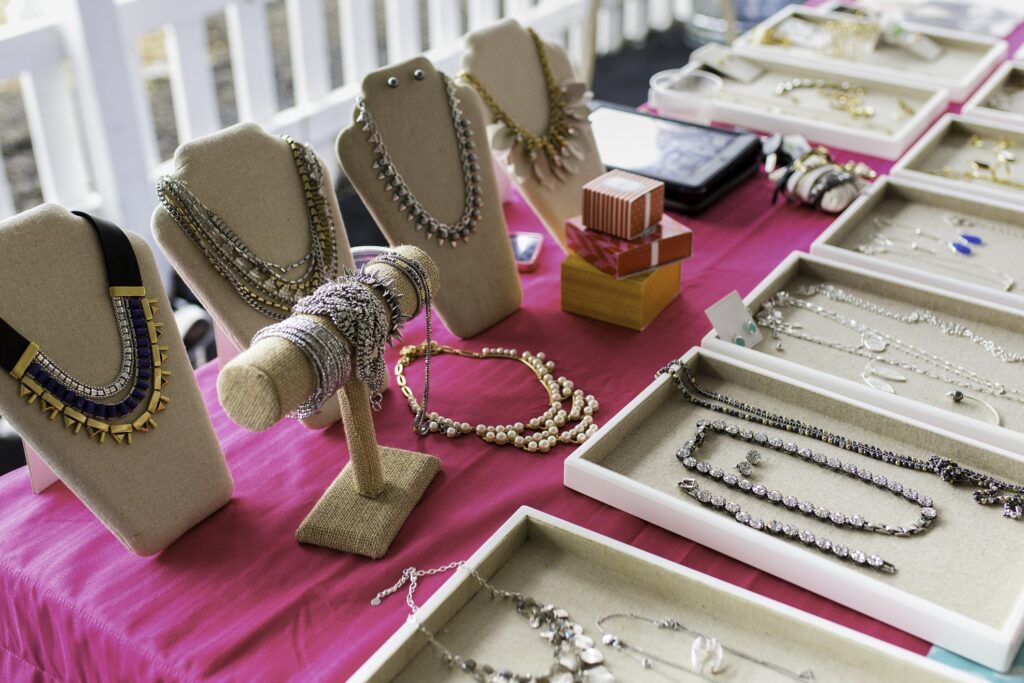
Blue Susan Makes’ craft fair display tips suggests grouping items in threes or fives instead of spreading everything evenly. It costs nothing, and it’s a good reason to bring a few extras of your best seller so the group still looks full after a sale.
6. Use the back wall
The space behind your table can hold hanging items, prints or a banner. A 2-pack of 2 by 5.5 foot gridwall panels with bases was about $81, so roughly $41 a panel, and CreativeLive’s craft show display ideas suggests old pallets for hanging goods as a very low cost option. If money is tight, gridwall is the first thing I’d cut from a first booth, since it and a second table add about $200 between them.
7. Add light
Indoor halls and covered tents can be dim, and jewelry, glass and anything shiny looks better under light. Battery fairy lights cost about $5 to $15 a pack, which makes them one of the cheapest upgrades here. Check first whether your show offers power, since Franklin charged $75 in advance for electric and Moore Square charges a separate fee when you request it.
8. Put your name on a sign
A sign with your shop name helps shoppers find you again later or look you up online, and one printed at home on cardstock costs almost nothing. Vistaprint lists its vinyl banners in 28 sizes and says they’re certified to NFPA 701 for fire resistance, but its page didn’t show a price when I checked.
9. Price every item where people can see it
Pricing everything means nobody has to ask, and small tags, a chalkboard or a printed price list all work. Set the prices before the show with the pricing formula for handmade items, so your booth fee is covered.
10. Take cards
Square’s Square Reader is $59 for tap and chip cards, and Square’s fee page lists 2.6% plus 15 cents for in-person payments on its free plan. On a $25 sale that’s about 80 cents, which is worth adding to your prices.
11. Display your tax ID if the show asks
Some shows want your sales tax number on display. The Worthington fair says a tax ID must be shown at your booth and that sellers collect 7.5% sales tax, and the Violet Crown Festival in Texas asks for your tax ID certificate in the booth. In California, the CDTFA says a temporary seller’s permit is free and covers a selling period of 90 days or less at one location. Rules differ by state, so check yours before your first show.
12. Bring proof of insurance if it’s required
Handmade Arcade in Pittsburgh asks makers to provide crafters liability insurance, while Franklin and Fairfax only strongly recommend it. ACT’s craft fair insurance listed $49 to cover a 1 to 3 day event, or $279 for a year, which makes the yearly plan worth it once you’re doing six or more shows.
What craft shows charge for a booth
These are 2026 fees from each show’s own page for sellers or its application, for a 10 by 10 space unless noted, and 2027 fees may be different.
| Show | Where | Booth fee | Entry fee |
|---|---|---|---|
| Worthington Holiday Craft Fair | Worthington, OH | $50 | None |
| Fairfax Fall Festival | Fairfax, VA | $170 | $15 |
| Fairfax Holiday Craft Show | Fairfax, VA | $225 to $275 | $15 |
| Makers Arcade (holiday) | San Diego, CA | $405 | $20 |
| Main Street Festival | Franklin, TN | $450 | $40 |
| Handmade Arcade (holiday) | Pittsburgh, PA | $450 | $25 |
| Moore Square Winterfaire | Raleigh, NC | $500 + 6% | None |
| Crafty Wonderland (holiday) | Portland, OR | $575 | $10 |
The Worthington fair and the Fairfax Holiday Craft Show are indoors, and Worthington supplies a table and chair and doesn’t list a booth size. Moore Square’s fee includes a tent, weights and a string of lights plus a 6% booking fee, and Crafty Wonderland credits its $10 entry fee toward the booth if you’re accepted.
What a first booth costs
I priced two versions of a first outdoor booth. The budget booth is a $76 canopy, a $43 set of water weights that holds about 55 pounds a leg, a $36 table, a $13 pair of table covers, $12 of risers, $5 of lights, a home-printed sign and the $59 Square Reader, for about $244. The mid booth swaps in E-Z UP’s $250.80 Vantage canopy, two sturdier tables at about $120 each, $15 of table covers, $56 of risers, an $81 pair of gridwall panels and $15 of lights, for about $760 before a printed banner. Neither includes chairs, a cart, packaging or your stock, and an indoor show that supplies the table needs only the covers, risers, lights and card reader, about $89. The links below go to listings close to what I priced, if you want to compare current prices.
- ABCCANOPY 10 by 10 pop-up canopy
- FRUITEAM water weight bags, set of 4
- 6 foot fold-in-half table
- 2 by 5.5 foot gridwall panels, 2-pack
As an Amazon Associate I earn from qualifying purchases. The Amazon links here pay me a small commission at no extra cost to you.
Can a craft fair pay for itself?
I couldn’t find any published survey of what sellers make at a show, only estimates from bloggers that don’t say where they came from, so I worked out what you’d need to sell to break even instead. I spread the setup over five shows and assumed you keep half of each sale after the cost of making the item, which is my assumption and not data, and I left out card fees and your time.
| Show (booth plus application fee) | Sales to break even, budget setup | Sales to break even, mid booth |
|---|---|---|
| Worthington, indoor ($50, indoor setup only) | $136 | Not needed |
| Fairfax Fall Festival, outdoor ($185) | $468 | $674 |
| Franklin Main Street Festival, outdoor ($490) | $1,078 | $1,284 |
Is a craft fair worth it? It can pay off at a small local show, but I’d wait on the $450 and up shows until you know your numbers.
- What it takes: about $244 for a budget outdoor booth or about $89 for an indoor show that supplies the table, plus a booth fee of $50 to $575 at the shows I checked, and $49 for event insurance where it’s required.
- What you’d need to sell: about $136 at a $50 indoor community fair to break even, or over $1,000 at a $490 outdoor festival with the budget booth.
- My take: a cheap local fair is the place to learn what sells and pay off your setup. Kelsey Haver’s craft market tips repeat a common rule of thumb that you should sell 10 times your booth fee, which is a much higher bar than break even.
If you still need something to sell, my list of things to make and sell compares Etsy prices for 13 crafts, and woodworking projects that sell covers bigger pieces. These small business packaging ideas help with bags and wrapping at the booth, and the guide to selling on Etsy shows how to set up a shop where fair shoppers can buy from you later.
Good luck with your first show, and I hope the weather is kind!
Leave a Reply